Short answer
If your Lp(a) is high, the treatment with the strongest evidence is lowering your LDL cholesterol (LDL-C) and ApoB hard and keeping them there. On November 7, 2026, the full Lp(a)HORIZON results showed that pelacarsen, a drug made to lower Lp(a), cut it by 78% but didn't reduce heart attacks or strokes. LDL-lowering medicines have reduced events in trial after trial, including in people with high Lp(a).
What the pelacarsen trial found
Lp(a)HORIZON was the first large trial to test whether a drug built to lower Lp(a) prevents heart attacks and strokes. It enrolled 8,350 adults with established heart or vascular disease and an Lp(a) of 70 mg/dL (148 nmol/L) or higher, at 797 sites in 42 countries. Half got a monthly 80 mg pelacarsen injection, and half got a placebo injection, for a median of about 5 years.
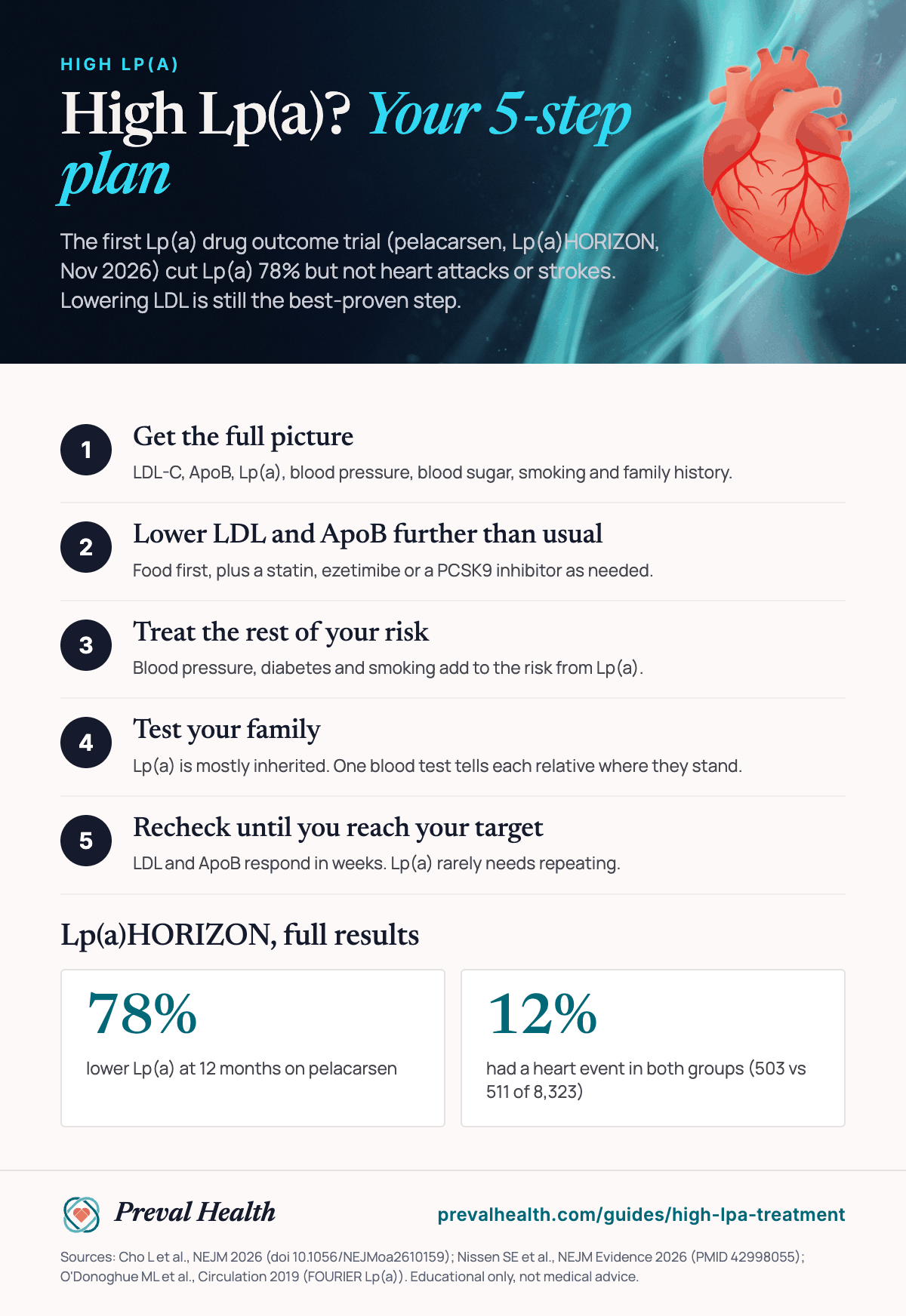
Lp(a) fell by 78% at 12 months on pelacarsen, but heart events stayed the same. The main outcome (heart attack, stroke, urgent procedure to open a heart artery, or death from heart disease) happened in about 12% of each group: 511 people on pelacarsen and 503 on placebo.
Lp(a)HORIZON, full results (November 7, 2026)
Source
Cho L, Nicholls SJ, Frndak S, et al. “Pelacarsen and Cardiovascular Outcomes in Patients with High Lipoprotein(a).” New England Journal of Medicine (2026).
View paperThe extended analyses, published the same day in NEJM Evidence, looked for any group that benefited and found none. Counting every event, first and repeat, the pelacarsen group had 644 and the placebo group 646. People whose Lp(a) fell the most by 3 months (a drop of 170 nmol/L or more) did no better than people on placebo (hazard ratio 1.09). The result held in subgroups by starting Lp(a), LDL-C and inflammation (hs-CRP).
Source
Nissen SE, Cho L, Frndak S, et al. “Extended Analyses of Pelacarsen and Cardiovascular Outcomes in Patients with High Lipoprotein(a).” NEJM Evidence (2026).
View paperPelacarsen also caused more flu-like symptoms, injection-site reactions and allergic reactions. Anaphylaxis occurred in 19 people on pelacarsen and none on placebo, and about 21% of people on pelacarsen stopped it because of side effects, compared with more than 7% on placebo, according to the American Heart Association's summary.
The researchers note limits: the trial included only people who already had heart disease, and the result applies to pelacarsen. Steven Nissen, the senior author, said the result doesn't mean Lp(a) is irrelevant.
Key Takeaway
Pelacarsen lowered the Lp(a) number without lowering heart attacks or strokes. A high Lp(a) still raises your risk, so the rest of your plan matters more.
Infographic
Share this infographic
Free to share and embed on your site with credit and a link to this page.
Why lowering LDL cholesterol is still the best treatment
LDL-lowering medicines have prevented heart attacks and strokes in trial after trial. Across 26 statin trials and about 170,000 people, each 39 mg/dL (1 mmol/L) drop in LDL-C cut major heart and stroke events by about 22%.
Source
Cholesterol Treatment Trialists' (CTT) Collaboration “Efficacy and safety of more intensive lowering of LDL cholesterol: a meta-analysis of data from 170,000 participants in 26 randomised trials.” The Lancet (2010).
View paperPeople with high Lp(a) benefit from that too, and sometimes more. In the FOURIER trial of evolocumab (Repatha), people whose Lp(a) was above the median had a 23% lower risk of coronary heart death, heart attack or urgent procedure on the drug. People below the median had a 7% lower risk. Because their starting risk was higher, the people with higher Lp(a) gained more: 40 needed treatment for 3 years to prevent one event, compared with 105.
Source
O'Donoghue ML, Fazio S, Giugliano RP, et al. “Lipoprotein(a), PCSK9 Inhibition, and Cardiovascular Risk.” Circulation (2019).
View paperThe ODYSSEY OUTCOMES trial of alirocumab (Praluent) found the same pattern after a recent heart attack or unstable angina: the drop in LDL-C and the smaller drop in Lp(a) each predicted fewer events.
Source
Bittner VA, Szarek M, Aylward PE, et al. “Effect of Alirocumab on Lipoprotein(a) and Cardiovascular Risk After Acute Coronary Syndrome.” Journal of the American College of Cardiology (2020).
View paperOur view at Preval Health: until an Lp(a) drug proves it prevents heart attacks, a high Lp(a) is a reason to push LDL-C and ApoB lower than you otherwise would, and to keep them there.
What to do if your Lp(a) is high
Step by step
Next steps with a high Lp(a)
- Time
- About 10 minutes to plan
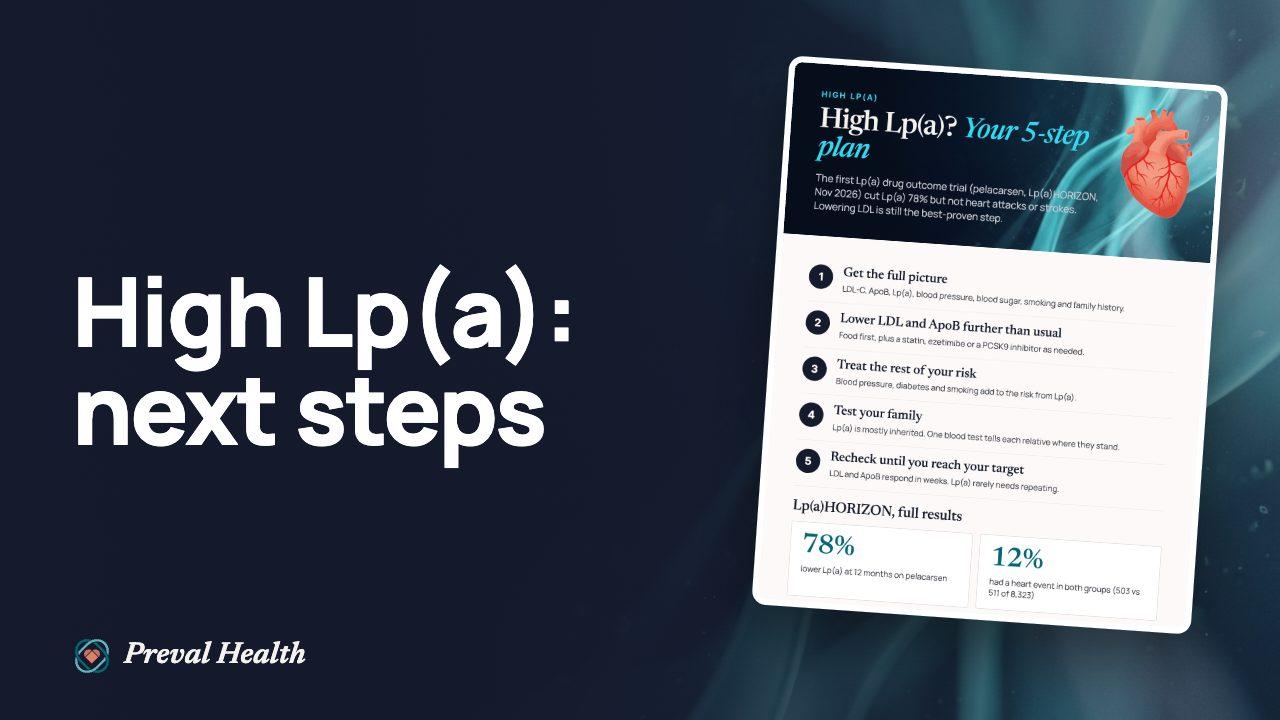
Get the full picture
Your Lp(a) is one number. Your clinician also needs LDL-C, ApoB, triglycerides, blood pressure, blood sugar, smoking history and your family history to judge your overall risk. Our guide on how to get an ApoB and Lp(a) test covers what to ask for.
Lower LDL cholesterol and ApoB further than usual
Food and exercise come first, and most people with high Lp(a) also need a prescription on top. A statin is usually the first medicine. Ezetimibe adds to it. A PCSK9 inhibitor lowers LDL-C sharply and Lp(a) by about a quarter as a side benefit. Your clinician sets an optimized target based on your risk. See how to lower ApoB for how much each option does.
Treat the rest of your risk
Blood pressure, diabetes and smoking add to the risk from Lp(a). Controlling them matters more when your Lp(a) is high.
Test your family
Lp(a) is mostly inherited, so parents, siblings and children have a good chance of a high level too. One blood test tells each of them where they stand. Our guide on whether high cholesterol is genetic explains how it runs in families.
Recheck until you reach your target
LDL-C and ApoB respond to treatment within weeks. Rechecking every few months and adjusting the plan is how you get to your target and stay there. Lp(a) itself rarely needs repeating, because it stays fairly stable for life.
Can you lower Lp(a) naturally?
Not meaningfully. Your genes set most of your Lp(a), and diet and exercise barely move it. They still lower LDL-C, blood pressure and blood sugar, so they lower your total risk.
Niacin lowers Lp(a) somewhat, but it hasn't prevented heart attacks. In AIM-HIGH, the main outcome happened in 16.4% of people on niacin and 16.2% on placebo. In HPS2-THRIVE, it was 13.2% and 13.7%, and niacin caused more serious problems with diabetes control. Neither trial selected people for high Lp(a).
No food needs to be avoided for Lp(a) itself. Eating to lower LDL-C still helps: less saturated fat, more fiber, beans, nuts, vegetables and whole grains.
What high Lp(a) means for your long-term health
A high Lp(a) raises the chance of a heart attack, stroke or aortic valve narrowing over a lifetime. It doesn't decide your outcome on its own. Your LDL-C, ApoB, blood pressure, blood sugar and smoking shape what happens, and you can change all of them.
Most heart disease is preventable. With a high Lp(a), you start earlier and treat your other numbers harder.
What's next for Lp(a) drugs
Other drugs built to lower Lp(a) are still in outcome trials: the siRNA injections olpasiran and lepodisiran, a different technology from pelacarsen, and the daily pill muvalaplin. A third siRNA, zerlasiran, hasn't started one yet. These drugs cut Lp(a) by 70% to more than 90% in earlier trials. Their outcome results are expected from 2028 onward, and pelacarsen's result doesn't predict them either way. Our guide to emerging Lp(a) therapies tracks where each one stands.
How Preval Health helps with high Lp(a)
Preval Health is a cash-pay telehealth practice for prescription cholesterol treatment. Membership includes baseline labs with Lp(a), ApoB and a full lipid panel. A licensed clinician from our partner network reviews your results, sets an optimized target based on your risk and prescribes treatment if it fits. Lipid panel and ApoB rechecks come every 3 months until you reach your target. A board-certified cardiologist focused on prevention designed the protocols.
If you've just learned your Lp(a) is high and want a plan, join the waitlist.