Short answer
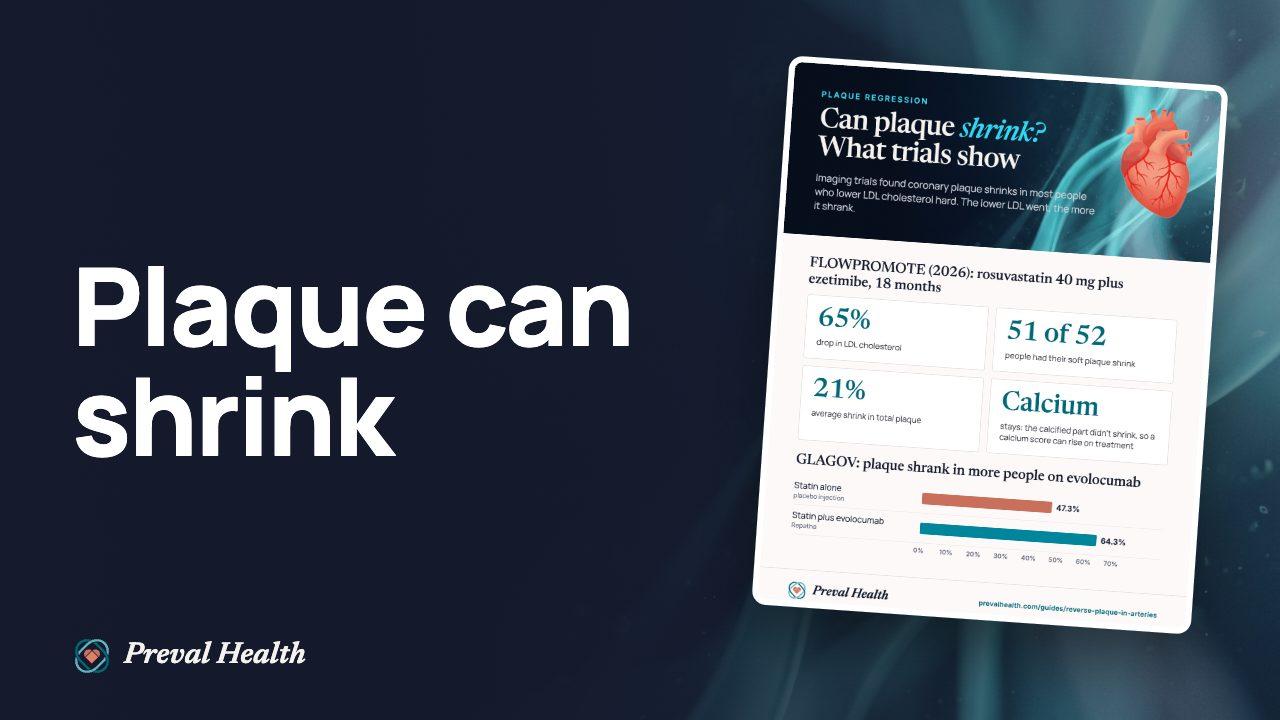
Yes, plaque in the heart arteries can partly shrink. In the 2026 FLOWPROMOTE trial, people newly diagnosed with coronary artery disease who took rosuvastatin 40 mg plus ezetimibe cut their LDL cholesterol by 65%, and their soft plaque shrank in 51 of 52 cases. The lower LDL went, the more plaque shrank. The calcified part of plaque doesn't go away.
What "reversing plaque" means
Plaque builds up inside the walls of the heart arteries over decades. It's made of cholesterol carried in by LDL particles, plus scar tissue, inflammatory cells and, over time, calcium. Doctors call a drop in plaque size "regression".
Two kinds of plaque matter here:
- Soft (noncalcified) plaque is newer and still full of cholesterol. It's linked to higher risk of a heart attack, and it's the kind that can shrink.
- Calcified plaque has hardened. It shows up on a calcium score and doesn't dissolve.
Reversal here means soft plaque shrinking and the remaining plaque becoming more stable. Arteries rarely return to perfectly clean.
Infographic
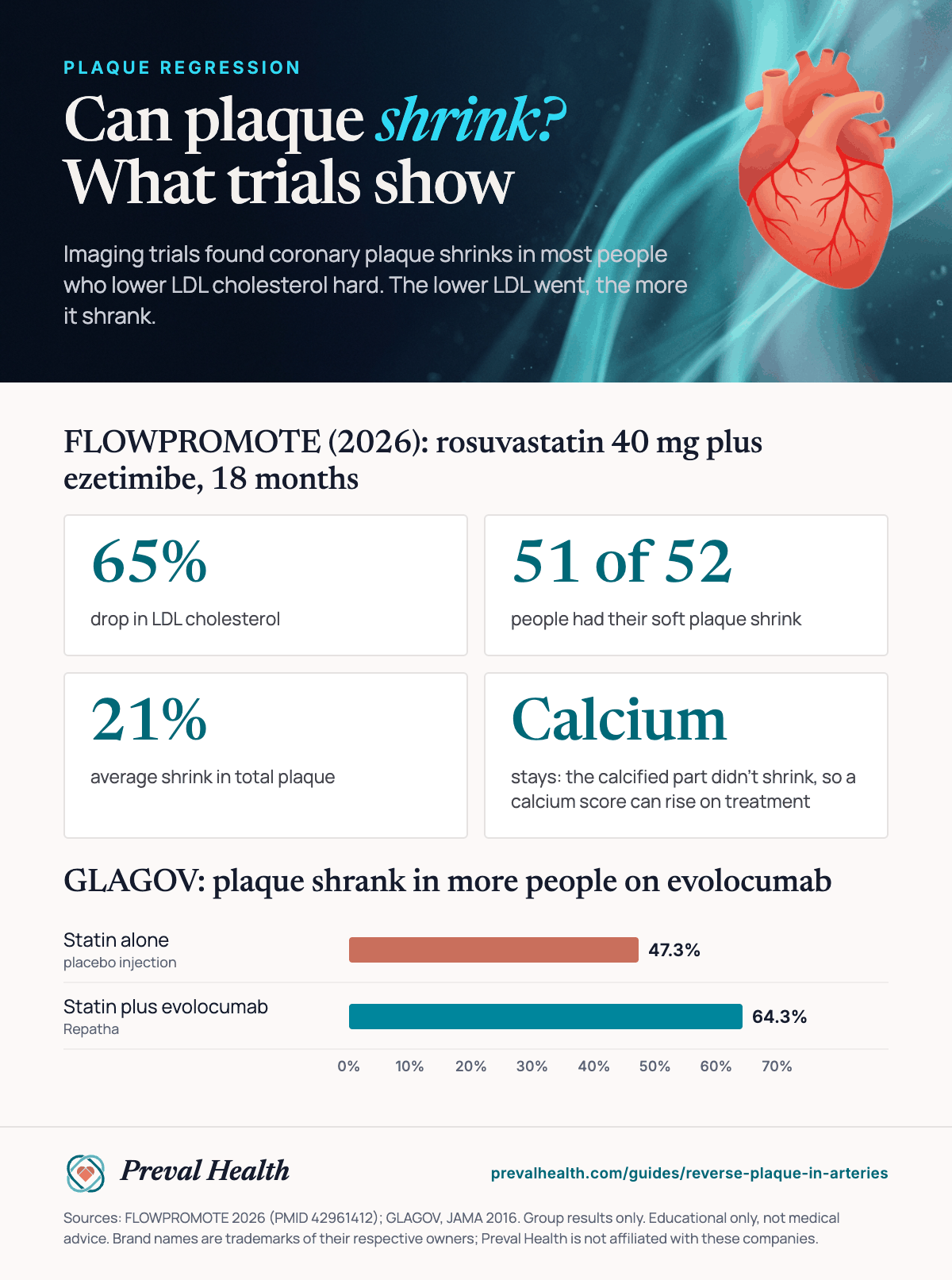
Share this infographic
Free to share and embed on your site with credit and a link to this page.
What the FLOWPROMOTE trial found
FLOWPROMOTE was a randomized trial that enrolled 104 people, average age 64, who had just been diagnosed with stable coronary artery disease on a CT angiogram and had never taken a statin. Half took atorvastatin 40 mg. The other half took rosuvastatin 40 mg plus ezetimibe 10 mg, a stronger combination. Everyone had repeat CT scans at 9 and 18 months to measure plaque in all the heart arteries.
FLOWPROMOTE: 104 people newly diagnosed with coronary artery disease, never on a statin, scanned with CT angiography before and after 18 months of treatment.
Average change after 18 months
LDL cholesterol
Total plaque
Soft (noncalcified) plaque
Bars show the size of the drop.
People whose plaque shrank
Total plaque shrank
Soft plaque shrank
Bars show the share of each group.
Show as a table
| Result | Atorvastatin 40 mg | Rosuvastatin 40 mg + ezetimibe |
|---|---|---|
| LDL cholesterol | −38% | −65% |
| Total plaque | −13.6% | −21.1% |
| Soft (noncalcified) plaque | −20.0% | −28.2% |
| Total plaque shrank | 38 of 51 | 47 of 52 |
| Soft plaque shrank | 39 of 51 | 51 of 52 |
Source: Mortensen MB, et al. FLOWPROMOTE, prespecified secondary analysis. JAMA Cardiology, 2026. A small imaging trial: it measured plaque, not heart attacks or strokes.
After 18 months:
- LDL fell 38% on atorvastatin (from 119.7 to 69.5 mg/dL) and 65% on the combination (from 127.4 to 42.5 mg/dL).
- Total plaque shrank in both groups, by 13.6% on atorvastatin and 21.1% on the combination.
- Soft plaque shrank more, by 20.0% and 28.2%.
- Soft plaque shrank in 51 of 52 people on the combination, against 39 of 51 on atorvastatin.
- Calcified plaque grew a little, by a similar amount in both groups.
- Lower LDL went with more regression in a straight line, across everyone in the trial.
Source
Mortensen MB, Iraqi N, Sand NPR, et al. “Intensive vs More Intensive Lipid-Lowering Therapy and Plaque Regression in Statin-Naive Patients: Prespecified Analyses From the FLOWPROMOTE Randomized Clinical Trial.” JAMA Cardiology (2026).
View paperWhat this trial can and can't tell you
FLOWPROMOTE is small, and these results come from a prespecified secondary analysis. It measured plaque on scans and didn't count heart attacks or strokes. Most participants were men. Still, it fits a decade of earlier imaging trials, and it measured plaque across the whole coronary tree with CT, a scan that doesn't need a catheter.
Earlier trials point the same way
Before FLOWPROMOTE, most plaque studies used ultrasound or light-based imaging from a catheter inside the artery. They all found the same pattern: more LDL lowering, more regression.
- GLAGOV (2016): in 968 people on a statin, adding evolocumab (Repatha) lowered average LDL to 36.6 mg/dL, against 93.0 mg/dL on statin alone. Plaque volume shrank with evolocumab and held steady on placebo.
- PACMAN-AMI (2022): in 300 people treated for a heart attack, adding alirocumab (Praluent) to rosuvastatin 20 mg shrank plaque more than twice as much as the statin alone.
- HUYGENS (2022): after a heart attack, evolocumab took LDL to 28.1 mg/dL and thickened the fibrous cap that covers plaque, a change linked to more stable plaque.
These imaging trials match the outcome trials. Across 26 statin trials, each 39 mg/dL (1 mmol/L) drop in LDL cut major heart attacks, strokes and artery procedures by about 22%.
How to lower LDL enough to shrink plaque
The trials share one thread: the people whose LDL went lowest had the most regression. In practice that usually takes one of these steps, alone or together:
- A high-intensity statin, such as rosuvastatin 20 to 40 mg or atorvastatin 40 to 80 mg. Our rosuvastatin vs atorvastatin guide covers how they differ.
- Adding ezetimibe, a daily generic pill that blocks cholesterol absorption in the gut. It's the add-on FLOWPROMOTE used. See our ezetimibe guide.
- Adding a PCSK9 inhibitor when LDL is still above goal, or when statins cause trouble. See PCSK9 inhibitors explained.
- Food, exercise, weight and not smoking, which lower LDL and other risks on their own and add to medicine. Our guide to lowering LDL has the details.
Your goal depends on your risk: whether you already have plaque, a heart attack in the past, diabetes, very high LDL or a strong family history. A clinician sets it with you and rechecks your labs until you reach it.
How plaque is measured
A calcium score is a quick, low-dose CT scan that finds only calcified plaque. A score of zero means lower risk, but it can miss soft plaque. A coronary CT angiogram uses contrast dye to show soft and calcified plaque and any narrowing. FLOWPROMOTE used CT angiography. Our calcium score guide explains what each result means. Whether you need a scan depends on your symptoms and risk, so ask your doctor.
The bottom line
In trials, lowering LDL hard made soft plaque shrink in most people, and the lowest LDL brought the most regression. Starting early means less plaque builds up in the first place. Don't wait for symptoms.